Jun 1, 2021
Our first ever TDRN UK Network Session was an opportunity for us to explore what members of the group were interested in discussing and sharing information and experiences about. Initial topics included:
- How to teach and educate learners about the histories and culture of tap dance
- Different ways of making tap dance performance work
- The life stories of tap dancers
- The history of tap dance in the UK and it’s relationship to tap dance communities in North America
- The aesthetic angle in tap dance teaching
- The ways that tap dance influences other art forms
Salon Bam led by Jess Murray: How do we reflect the culture and histories of tap dance in our research?
Jess opened up a discussion by introducing her Ph.D practice research project which looks at how ideas and themes are communicated in making dance and music collaborative improvisation-as-performance work. Jess shared questions that have arisen for her as a result of framing her own tap dance practice in a research context. This also highlights some of the tensions in the relationship between tap dance and academic institutions which need to be addressed in order to do ethical and effective research.
Jess spoke about the need to approach her research in a way that fits her own practice (improvisation, collaborative, community oriented) and is appropriate for tap dance as an art form/ cultural perspective which can often be at odds with mainstream academia. Doing ‘practice research’ which places physical experience at the centre of the learning is helpful, but other issues remain…
For example –
- As an Oral history, there are not extensive written records so other methods are needed to gather information
- Tap Dance aesthetics differ from dance and music forms that are more prevalent in academia. There is a need to develop alternative approaches that come from the perspective of tap dance rather than ‘borrowing’ from something else that ‘doesn’t fit’
- Discussion around improvisation by jazz music and Improvisation Studies scholars is useful, but at present there is very little that connects with tap dance as both dance and music.
The conversation then opened up to the group in response to the questions raised. Sally Crawford-Shepherd shared her experiences of doing an Ethnographic study of UK Tap Jams. Discussed Ethnography as a tool to create a portrait of people. Participatory observation. Story of the people.
Areas of future interest raised by the group included:
- Wooden tap shoes
- Discussion about tap dance a folk dance and other percussive folk dance forms that we are interested in such as British clog dance and Irish Sean-nós dance which is improvisatory. https://en.wikipedia.org/wiki/Sean-n%C3%B3s_dance
- We would like to know more about the early history or ‘pre-history’ of ‘tap’ dance and the experiences of those that were dancing at the time. Might there be experimental and innovative approaches to history that can reveal more in cases where certain oral history may have been lost? In addition to the oral tradition, what other ways of doing historical research through physical experience are there…?
- Considering tap dance from the perspectives of Folk tradition, Vernacular and popular culture, visual music. Thinking about ways of working with oral and embodied histories, and how this connects with written histories.
Resources mentioned in the session:
- BERLINER, Paul F. (1994) Thinking in Jazz: The Infinite Art of Improvisation. Chicago: University of Chicago Press.
- WRAY, S “Just after the pulse, rhythm takes all: the inside habitat of improvisation” in ADAIR, C and BURT, R (2017) British Dance: Black Routes. Routledge.
- WELSH-ASANTE, Kariamu ‘The “Gospel” of Memory Inscribed Bodies in the African Diaspora’ in WELSH-ASANTE, Kariamu et al (2019) Hot Feet and Social Change : African Dance and Diaspora Communities. University of Illinois Press.
- CARLOZZO, Abby ‘Embodying Rhythm Improvisation as Agency in African Dance’ in WELSH-ASANTE, Kariamu et al (2019) Hot Feet and Social Change : African Dance and Diaspora Communities. University of Illinois Press.
- HEBLE, A, CAINES, R (2014) The Improvisation Studies Reader: Spontaneous Acts. Routledge
- WILLIS, Cheryl. ‘Tap Dance: Manifestation of the African Aesthetic’ in WELSH-ASANTE, Kariamu. (1998) African Dance: An Artistic, Historical and Philosophical Inquiry Africa World Press, New Jersey
- OLIVER, W & GUARINO, L (2014) Jazz Dance: A History of the Roots and Branches. Gainesville, Florida: University Press of Florida
Travis Knight’s podcast about re-naming tap dance suggested. Tap. Love. Tour. Hosted by Travis Knights. Originally first recorded on April 3, 2015. Travis Knights’ Website Soundcloud Stitcher Apple.com
Jacobs Pillow Interactive Resources https://www.jacobspillow.org/school/
May 14, 2021
Wednesday 2 June 2021
In this session we discussed academic approaches of studying popular culture, how popular culture is approached in dance scholarship, and where tap dance fits into these topics. We started off the session with these questions to consider:
- How is tap dance portrayed in popular culture in the late 20th and 21st centuries?
- What makes something part of popular culture and who decides that?
- How can we engage in the discourse of popular culture and dance, e.g., within the jazz dance continuum or trends such as TikTok?
- What are opportunities, challenges, impacts of thinking about tap dance from the perspective of popular culture?
- How does considering tap dance as part of popular culture affect the way we tap dance, educate, create, function commercially?
Sally Crawford-Shepherd shared definitions of popular culture, such as how it is a collection of artefacts like films, music albums, and television programmes. However, popular culture often has different definitions due to individual cultures, groups, or societies having shifting values of what they perceive to be popular. She shared how popular culture is approached in academia through frameworks and theories such as The Frankfurt School, Feminist Theory, Marxism, Mass Culture studies, Mass Media, and Popular Music.
The discussion also covered how popular culture is approached in Dance Studies, and how the terms ‘social dance’, ‘vernacular dance’, and ‘popular dance’ are often used interchangeably. She shared Sherril Dodds’ work on popular dance studies, referencing how ‘[a] burgeoning interest in popular dance came to the fore in the 2001 winter edition of Dance Research Journal, which was devoted to ‘social and popular dance’. That an entire issue centred on dance practices situated outside the hallowed ground of the theatre dance canon indicated a nascent shift in dance studies towards an increasingly relativist position’ (Dodds 2011, 45). She included references for the group to explore (listed below) and another dance research group Pop Moves (popmoves.com) that shares and develops resources on popular dance research.
The discussion among the group included:
- Factors that performers and artists need to negotiate when working in the domain of popular culture. The group discussed examples where artists balance the integrity of the work and its connection to history and culture, with commercial factors which are also often needed to ensure the longevity of careers and success of the art form. We discussed the importance of key tap dance role models that exist in the domain of popular culture and the positive influences that individuals can exert when popularity is achieved with integrity.
- The role of social media and online phenomenons such as TikTok and YouTube in creating a greater presence for tap dance as popular culture. We discussed examples of tap dancers that have been successful in engaging with this and the affect it has had upon their profile and careers.
- The group discussed the numerous ways in which a practice such as tap dance can shift as it moves from being a practice within a specific community to a ‘popular’ form. This process involves not only artists and performers, but also producers, directors etc.
- The ways in which popular culture generates opportunities that are important to the continued success of a dance form. In this way, pop culture is relevant in terms of providing access to ‘gate keepers’ in the performing arts sector and industry.
Resources:
An Introduction to Theories of Popular Culture by Dominic Strinati
Cultural Theory and Popular Culture: An Introduction by John Storey
Beyond Blackface: African Americans and the Creation of American Popular Culture 1890-1930 by W. Fitzhugh Brundage
Dancing on the Canon: Embodiments of Value in Popular Dance by Sherril Dodds
Bodies of Sounds: Studies Across Popular Music and Dance by Sherril Dodds and Susan C. Cook
Ballroom, Boogie, Shimmy Sham, Shake: A Social and Popular Dance Reader Edited by Julie Malnig
The Oxford Handbook of Dance and Competition Edited by Sherril Dodds
The Oxford Handbook of Dance and the Popular Screen Edited by Melissa Blanco Borelli
May 11, 2021
We are thrilled to be presenting a Panel at the Modes of Capture Symposium held by the Irish World Academy, University of Limerick, Liz Roche Company & Dublin Dance Festival. This year’s symposium explores the theme of decolonising structures, thinking and embodiment within current modes of dancemaking and documentation.
‘Tap Dance Knowldges’ is a panel exploring the concepts of legacy, tradition, innovation and authenticity within today’s global tap scene.
This paper/practice sharing discusses tap improvisation practices as knowledges in teaching, creative process and performance. We explore the concepts of legacy, tradition, innovation and authenticity, as well as reflecting on the rich and diverse global tap scene of today. An important part of skill acquisition, transmission and dissemination of information about the art form is from preservation of twentieth century American tap performance repertoire and understanding of improvisation practices from jazz music. Applying a historical framework reveals how this initiated with the performances of American tap dancers being celebrated and presented as a form of legacy. Our questions are: How and where are these knowledges held? What role does legacy have in evolving performing knowledges? How do we acknowledge the history and legacy of American tap dancers and produce new knowledges in the twenty first century?
Furthermore, we explore the under-representation of tap dance in UK Higher Education, in teaching and research. We advocate for rethinking curricula and decolonization of tap dance as a form created through African American cultural practices. The UK has a particular context within which tap dance sits, linked to the US, Ireland and other communities. We seek ways to highlight cross-disciplinary connections and evolving interpretations of tap dance legacies, different methods of practice and performance that may evoke new knowledges, the importance of communities of practitioners in disseminating information, performer identities and embodying new knowledges.
Apr 29, 2021
Tickets: £6 / £4 book here
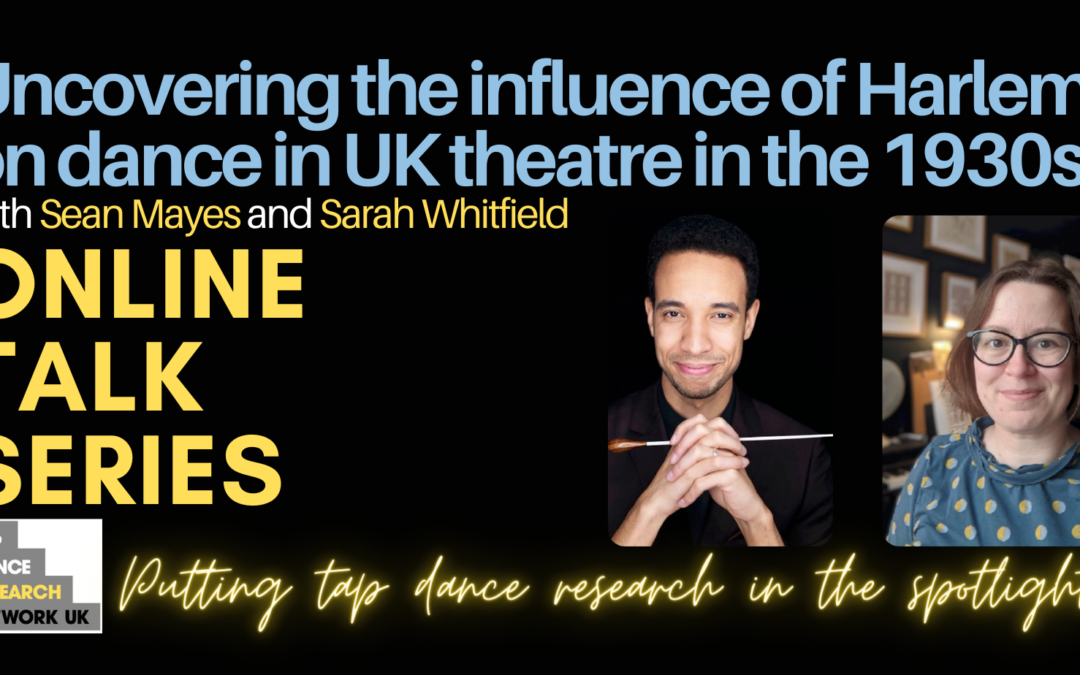
Presentation by Sean Mayes and Sarah Whitfield followed by Q&A and open discussion.
Though some key Black practitioners like Louis Armstrong and Cab Calloway’s visits to the UK are reasonably well known, the influence of Black dancers, choreographers and practitioners in the 1930s is little discussed despite their extensive presence in theatre in the UK. Many African American dancers like the Nicholas Brothers, Nyas Berry and Peg-Leg Bates performed not only in the West End but across the UK. Another aspect of Harlem theatre’s influence on the UK has been little considered, through the work of choreographers like Buddy Bradley who reshaped not only tap in the UK but also jazz ballet, and Clarence Robinson (known for his work at the Cotton Club and Stormy Weather) who worked in the UK for a year transplanting revues. We explore the work of these key figures, and the influence of practitioners from both the Caribbean islands and the mainland Caribbean region who had visited and worked in Harlem in the 1920s like Ken ‘Snakehips’ Johnson (born in Guyana) and Sam Manning (born in Trinidad). Join us as we uncover how Harlem theatre reshaped British dance practices.
Sean and Sarah are co-authors of An Inconvenient Black History of British Musical Theatre 1900 – 1950.
Sean Mayes is an MD & conductor, his work has involved productions on stages across the United States, Canada and the United Kingdom. He is an active member of the Broadway community as an MD, orchestrator-arranger, vocal coach, accompanist & pit musician. In Spring 2019, Mr Mayes was Music Director and Conductor of the all-Canadian premiere of The Color Purple. He is based between New York City and Toronto.
Sarah K. Whitfield is a Senior Lecturer in Musical Theatre at the University of Wolverhampton. She writes about the history of musical theatre, and recovering the work that women and minoritised groups through archival research and digital humanities. She is based in the West Midlands, UK.
Feb 25, 2021
Members of the steering group will host these informal but structured sessions that are FREE and open to all. You can connect with other people that are interested, or involved in doing research around tap dance.
Hear from researchers and practitioners about what they are working on and have learned through their projects. Learn about different approaches to learning in the field and pick up valuable tips and insights to help you pursue your own tap dance learning. A great opportunity to ask questions, swap tips for researching and developing projects, share information about resources and opportunities.
The next few sessions will explore what happens when we consider tap dance from certain perspectives such as Folk tradition, vernacular and pop culture, visual music… What does each of these viewpoints offer and what is the relationship between them?
**Next Session**
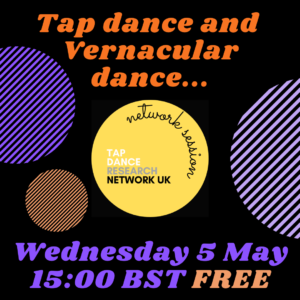
15:00 BST | 10:00 ET | 16:00 CEST
Following on from our last session that explored what happens when we consider tap dance from the perspective of Folk tradition, we now continue the journey through vernacular dance, pop culture, and social dance.
We will discuss how tap dance relates to these ideas before taking a deeper dive into vernacular dance. We will ask how appreciating tap dance as vernacular dance informs the way we dance, learn, educate, promote, discuss and research in tap dance…
Jess Murray will introduce the topic before opening it up to a conversation where different perspectives and experiences can be shared.
Book a FREE ticket
Facebook event